Shark IQ Filter Replacement: Which Filter Fits and When
In this guide
A Shark IQ robot with a self-empty base has three different filters, and they do not share a schedule or a cleaning method. This guide maps each one to Shark’s part number and interval from the RV1000AE Series owner’s guide, then compares Shark’s own parts with a third-party option. It is spec-based: sources are Shark’s manual and parts pages and the Amazon listing, checked 2026-11-10. Nothing was hands-on tested.
Disclosure: As an Amazon Associate I earn from qualifying purchases. Some brands featured below pay a bonus commission through Amazon Creator Connections. See /disclosure/.
Short answer: Shark IQ Self-Empty robots (RV1000AE series) use three filter types: the robot’s dust-bin filter (RVFFK950), the base’s pre-motor foam and felt kit, and the base’s post-motor filter. Shark’s manual says replace the base foam and felt every 2.5 years and the post-motor filter every 3 years.
The three Shark IQ filters
Shark’s RV1000AE Series owner’s guide (the self-empty IQ robot, which includes the RV1001AE) lists these parts and maintenance steps:
| Filter | Where it is | Part number (manual) | Clean | Replace (Shark) | Water? |
|---|---|---|---|---|---|
| Robot filter | Inside the robot’s dust bin | RVFFK950 | Tap off dust regularly | “Regularly”; no interval given | No, never wet it |
| Pre-motor foam and felt | Under the base dust bin | 106KY1000AE (now sold as XPMFRV1100) | Once a month | Every 2.5 years | Cold water only, no soap |
| Post-motor filter | Behind the filter door on the base | 107KY1000AE (SharkNinja lists 300KKU1000) | Once a year | Every 3 years | Cold water only, no soap |
The manual adds two related jobs: clean the cyclone filter inside the base dust bin with a small brush once a month, and replace the self-cleaning brushroll every 6 to 12 months or when visibly worn. Base filters must air-dry for at least 24 hours before going back in, so moisture is not drawn into electrical parts.
If your Shark IQ has no self-empty base, only the robot filter applies. If you are unsure which robot you have, check the model label on the robot and base or your receipt against the model lists on Shark’s parts pages below.
The robot filter (RVFFK950)
This is the small filter you pull out of the robot’s dust bin by its tabs. Shark is explicit: do not use water on it. Empty the bin, clear hair off the anti-tangle comb on the back of the bin, then lightly tap the filter to knock out dust and reinsert it until the bin clicks into place.
SharkNinja sells it as the Shark Robot Pre-Motor Filter, RVFFK950. Because Shark gives no month count, replace it when tapping no longer clears it, when it is torn or misshapen, or when suction drops and a clean bin and filter do not fix it. Our robot vacuum parts schedule tool lets you set your own interval and reminders, and how often to replace robot vacuum filters and brushes shows how other makers handle the same part.
The base pre-motor foam and felt filters
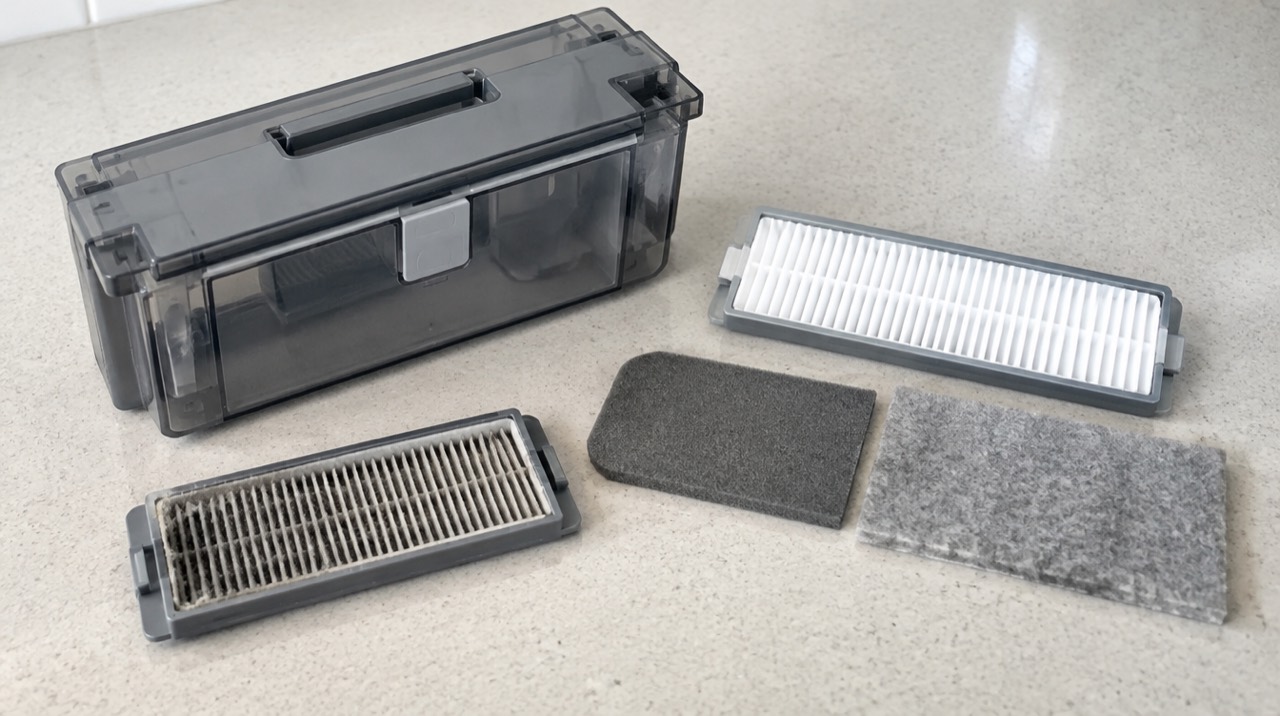
These sit under the base’s dust bin and catch what the robot dumps into the base before air reaches the motor. Shark says to lift out both pre-motor filters once a month, rinse them in cold water only (no soap, since cleaning chemicals can damage them), air-dry at least 24 hours, and replace them every 2.5 years.
Shark’s current kit is the Shark Robot Base Pre-Motor Filters, XPMFRV1100: one foam and one felt filter. SharkNinja lists it for a long run of models including the RV1001AE, RV1000S, UR1000SR, RV912S, AV911S, AV1002AE and the AI-series AV2501AE.
The base post-motor filter
The post-motor filter is the last stage before air leaves the base. Press the button at the top of the filter door, tilt the door off and lift the filter out. Shark says to clean it once a year (cold water, no soap, 24 hours to dry) and replace it every 3 years.
The manual’s part number is 107KY1000AE. SharkNinja’s parts store currently lists the Shark IQ Robot Base Post-Motor Filter, 300KKU1000, compatible with models including the RV1000AE, RV1001AE, RV1000S, RV912S, RV913S, AV911S and AV1002AE. Do not confuse it with 108KY1000AE, which is the filter door, not the filter.
Genuine Shark vs third-party filters
We could not find Shark-branded IQ filters sold by SharkNinja on Amazon on 2026-11-10; searches for RVFFK950, 107KY1000AE and Shark IQ filters returned third-party listings. Genuine parts are on SharkNinja’s own parts store, linked above.
See the Fre.Filtor RV1001AE Filter Replacement on Amazon and check the current price there.
| Shark genuine | Fre.Filtor (third-party) | |
|---|---|---|
| Maker | SharkNinja | Fre.Filtor |
| Post-motor | 300KKU1000 (107KY1000AE in the manual), one filter | 2 post-motor filters, “compare to 107KY1000AE” |
| Pre-motor | XPMFRV1100: 1 foam + 1 felt | 2 foam filters; felt not mentioned |
| Robot dust-bin filter | RVFFK950 | Not included |
| Replacement interval stated | Pre-motor 2.5 years, post-motor 3 years | Clean every 2 to 4 weeks, replace every 2 to 3 months |
| Where sold | SharkNinja parts store | Amazon |
| Warranty position | Shark’s manual requires Shark-branded filters | Seller’s own 30-day warranty |
Note the interval gap. Fre.Filtor’s listing suggests replacing every 2 to 3 months, which is far shorter than Shark’s 2.5 to 3 years for the base filters. Follow your Shark manual for the schedule; a cheaper filter replaced every few months can end up costing more over three years than one genuine set. If you do use a third-party filter, check that it seats fully and the filter door and bin close the same way they did with the original.
What Shark’s manual and warranty say about non-Shark parts
Shark’s owner’s guide is direct. Its safety instructions say to use only identical replacement parts, and item 11 says: only use Shark-branded filters and accessories; failure to do so will void the warranty. The same guide’s one-year limited warranty excludes normal wear parts, including foam filters, filters, brushrolls and batteries, and excludes damage from not performing required maintenance such as not cleaning the filters.
US federal law adds context. The FTC’s guide to the Magnuson-Moss Warranty Act says warranties generally may not require you to buy a specific brand of part to keep coverage, and it uses a vacuum cleaner and brand-name filter bags as its example of a prohibited tie-in; the exceptions are parts supplied free under the warranty or an FTC waiver. A warranty can still exclude damage caused by parts or service the warrantor did not provide (FTC Businessperson’s Guide to Federal Warranty Law). FTC staff have also said companies cannot void a warranty solely because a consumer used another company’s part (FTC, 2018).
In practice: filters are wear items Shark does not cover anyway, and federal guidance limits a blanket “void if non-Shark” clause, but if a third-party filter lets dust past and damages the motor, that damage could be excluded. This is general information, not legal advice. If your robot is inside its first year, using Shark’s own filters is the simplest way to avoid an argument with customer service. Shark’s support line in the manual is 1-888-228-5531.
Signs a filter is due
- Suction drops even with an empty robot bin and base bin.
- The base runs but leaves debris in the robot bin after emptying.
- Filters stay discolored or clogged after a rinse (base) or a tap (robot).
- Foam is torn, crumbling or misshapen, or a pleated filter’s frame is cracked.
- The app or robot shows a suction or blockage error; Shark’s troubleshooting chart pairs some error lights with “clean the filters, and remove blockages”.
Pet homes clog filters faster, so check monthly; our guide to the best robot vacuum for pet hair covers bin and brush choices that help. And if you are weighing whether a base is worth this extra upkeep at all, see is a self-emptying base worth it.
Mistakes to avoid
- Rinsing the robot filter. Shark says no water on RVFFK950; tap it instead.
- Using soap on base filters. Cold water only.
- Reinstalling damp filters. Give base filters at least 24 hours.
- Buying a kit for the wrong part. Post-motor, pre-motor and robot filters are different shapes; match the part number, not just “Shark IQ” in the title.
- Confusing the filter door with the filter. 108KY1000AE is the door.
- Replacing on a third-party seller’s schedule instead of Shark’s manual. Comparing other robots? Our best budget robot vacuum and mop combo covers the upkeep to check before you buy.
Frequently asked questions
How often should I replace the Shark IQ filters?
Shark's RV1000AE Series owner's guide says to replace the base's pre-motor foam and felt filters every 2.5 years and the base's post-motor filter every 3 years. It says to regularly clean and replace the robot's dust-bin filter but does not give a number of months for it.
Can I wash Shark IQ filters?
Only the base filters. Shark says to rinse the base's pre-motor foam and felt filters and post-motor filter with cold water only, no soap, and let them air-dry for at least 24 hours. The robot's dust-bin filter must not get wet; tap it clean instead.
What part number is the Shark IQ robot filter?
The filter inside the robot's dust bin is RVFFK950, which SharkNinja sells as the Shark Robot Pre-Motor Filter. The base uses a pre-motor foam and felt kit (106KY1000AE in the manual; sold now as XPMFRV1100) and a post-motor filter (107KY1000AE in the manual; SharkNinja lists 300KKU1000).
Will a non-Shark filter void my Shark IQ warranty?
Shark's manual says to use only Shark-branded filters and accessories and that failure to do so will void the warranty. The FTC's guidance on the Magnuson-Moss Warranty Act says a warrantor generally cannot void coverage just because you used another company's part, but can exclude damage that part causes. If you are under warranty, using Shark parts avoids the argument.
Is the Fre.Filtor RV1001AE filter a genuine Shark part?
No. It is a third-party filter sold by Fre.Filtor. Its listing says it is designed to fit Shark IQ self-empty bases and compares itself to Shark part 107KY1000AE, and it states that Shark names are used only to show compatibility.
Keep reading
- Best Budget Robot Vacuum and Mop Combo: Spec Picks
The best budget robot vacuum and mop combo for your floors, compared on navigation, mop design, height and upkeep. Spec-based picks from Roborock, iRobot and Shark.
Updated Nov 2026 - Lidar vs Camera vs Gyro Robot Vacuum Navigation
Lidar vs camera vs gyro robot vacuum navigation: how each one finds its way, what it can and cannot do, and which suits your home's size, lighting and clutter.
Updated Nov 2026 - Robot Vacuum Suction (Pa) Explained: What the Number Means
What robot vacuum suction in Pa actually measures, why 8,000 Pa on one robot is not 8,000 Pa on another, and what to compare instead before you buy.
Updated Nov 2026